License Number: 91441900MA4WN5MJ8Y
Suivez-nous :


Public Self-Service Kiosk (Project G639)
Hardware Integration Case Study
Engineering, component matching, and supervised production of a public self-service payment kiosk.
Self-Service Information Kiosk for Public Tax Payments
Eastern Europe | Industrial Design, Hardware Integration & Production Supervision
This hardware integration case study documents the engineering process, component matching, and supervised production of a public self-service payment kiosk.
Project Overview
Project G639 was developed for a Romanian IT company operating across Eastern Europe, specialized in software solutions for public administration and digital public services.
The client had completed the software platform for a self-service tax payment system intended for public environments. The project required a complete hardware ecosystem capable of supporting continuous operation, secure transactions, and scalable deployment.
SHAMANA was engaged to convert functional software requirements into a fully engineered, manufacturable, and deployable hardware system, while acting as the technical owner of the hardware process on behalf of the client.
Initial Client Input
The client provided:
-
functional requirements derived from the software architecture,
-
required user interactions and peripherals,
-
strict maximum external dimensions,
-
no industrial design,
-
no validated hardware architecture,
-
no production or quality control framework.
The challenge was not procurement, but end-to-end hardware engineering and execution control.
SHAMANA Scope of Work
SHAMANA assumed responsibility for the complete hardware lifecycle:
-
industrial design and hardware architecture,
-
component matching and technical validation,
-
factory selection and integration setup,
-
production supervision and quality control,
-
technical documentation,
-
deployment and commissioning readiness
-
Industrial Design & Hardware Architecture
SHAMANA defined the complete physical and technical architecture of the kiosk, translating abstract functional requirements into a coherent industrial product.
This included:
-
enclosure proportions and structural logic,
-
internal component layout and access paths,
-
thermal and electrical design constraints,
-
reinforcement for public-use environments,
-
compliance with all dimensional limits.
The result was a repeatable, serviceable industrial design, not a one-off prototype.
Custom Display & Touch Integration
To meet usability requirements, SHAMANA engineered a custom large-format interface:
-
32-inch industrial display,
-
customized projected capacitive touchscreen (CTP).
The integration required mechanical adaptation, precise alignment, signal compatibility validation, and long-term reliability assurance within the kiosk architecture.


System-Level Component Matching – Hardware Integration Case Study
Project G639 was engineered at system level, not component level.
The kiosk integrates:
-
industrial embedded PC,
-
32” custom display + CTP,
-
camera-based QR / barcode scanner,
-
thermal receipt printer,
-
Wi-Fi connectivity,
-
5G cellular connectivity for autonomous and redundant operation,
-
power conversion and internal cabling systems.
All components were selected and matched based on compatibility, reliability, serviceability, and lifecycle availability.


Connectivity & Computing Architecture
The system core is an industrial-grade computing platform designed for continuous operation.
Dual connectivity was implemented:
-
Wi-Fi for local network environments,
-
5G for independent operation and redundancy in public infrastructure deployments.
This architecture ensures operational continuity and flexible installation scenarios.
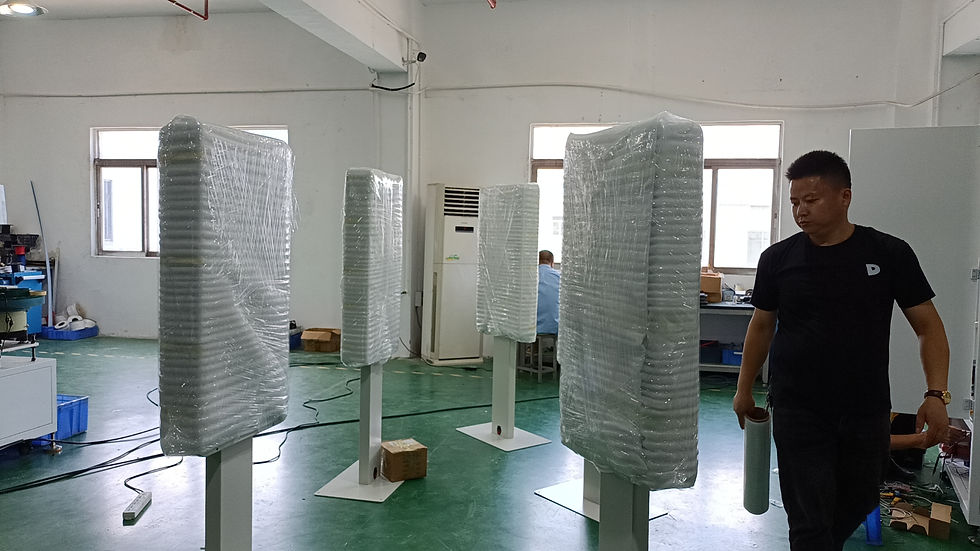
Factory Selection & Production Supervision
SHAMANA identified and coordinated a factory capable of full system integration.
Beyond design transfer, SHAMANA actively supervised the production process on behalf of the client, ensuring:
-
correct implementation of the approved design,
-
compliance with integration and assembly instructions,
-
consistency across all produced units,
-
early detection and correction of potential deviations.
Production supervision was performed as a technical control function, not as product ownership, ensuring the client received hardware aligned with the validated specification


Manufacturing Instructions & Factory Enablement
To support controlled production, SHAMANA developed a factory-specific assembly and installation manual, including:
-
step-by-step assembly instructions,
-
wiring and interconnection logic,
-
critical inspection checkpoints,
-
validated installation sequences.
This documentation enabled the factory to reproduce the system reliably and consistently.

Operation, Commissioning & Usage Documentation
SHAMANA also prepared:
-
an operation manual,
-
a commissioning and initial setup guide,
-
usage instructions adapted to public-service environments.
These documents ensure independent installation, commissioning, operation, and servicing of the kiosks.
Production & Deployment Status
-
The system was approved after prototype and validation phases.
-
Project G639 entered series production.
-
Approximately 80–100 units are currently deployed.
-
The kiosks are actively used for public tax payment services.


Technical Outcome
Through industrial design ownership, system-level engineering, production supervision, and comprehensive documentation, Project G639 evolved from a software-only concept into a stable, scalable public-service hardware platform.
The project demonstrates SHAMANA’s ability to:
-
engineer industrial hardware from functional requirements,
-
integrate complex multi-component systems,
-
supervise production on behalf of clients,
-
deliver deployable, service-ready hardware solutions.
Final Takeaway
Hardware integration does not end at design approval. It ends when production consistently delivers what was engineered.
Internal Reference
-
Project code: G639
-
Market: Eastern Europe
-
Application: Public self-service tax payment infrastructure
-
Status: In production and active deployment
