Structured Information Is What Creates Decision Clarity in China Projects

Most companies entering China sourcing believe they lack information.In reality, they lack structured information.
Quotes, specifications, supplier profiles and timelines are easy to collect.What is difficult—and often missing—is a clear structure that turns information into decisions.
At SHAMANA, after more than 15 years of working inside China sourcing and execution, we have learned a simple truth:China does not reward assumptions.
It rewards clarity and ownership.
Information alone does not create control
Many projects begin with a large volume of data:
multiple supplier offers
technical specifications
price comparisons
logistics options
Yet when execution begins, uncertainty appears quickly.
Who validates the supplier selection?Who owns technical compromises?Who decides when timelines shift or conditions change?
When these questions have no clear answer, information loses its value.Execution becomes reactive, and control fades.
Structure forces decisions early
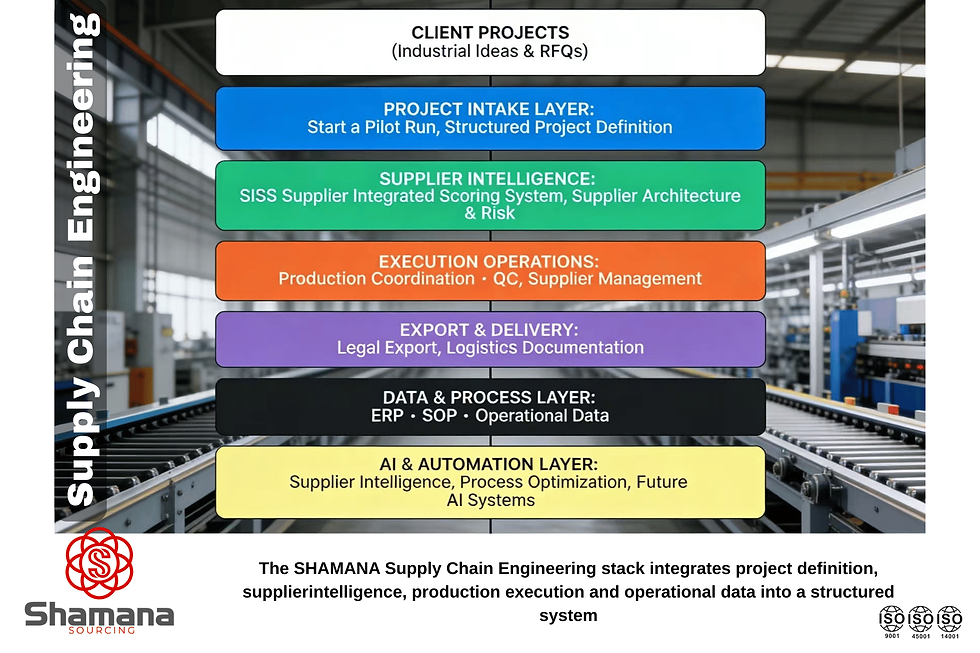
Structured information does something essential: it forces decisions to be made before execution.
When information is organized around:
scope definition
risk identification
responsibility allocation
decision ownership
assumptions become visible, and accountability is established.
This is the moment when a China project transitions from planning to controlled execution.
Without this structure, problems are not prevented—they are simply postponed.
Ownership is the real differentiator
Experience alone does not guarantee success.Ownership does.
We have seen junior teams execute well because responsibility was clear.And experienced organizations struggle because decisions were fragmented across departments.
In China, execution follows instructions literally.If decisions are unclear, execution will reflect that ambiguity.
Clear ownership reduces friction, delays and cost escalation.
Why we introduced “Start a Pilot Run”
Start a Pilot Run was designed as a structured decision-entry framework—not as a contact form.
Its purpose is to:
clarify decision ownership
identify risks before commitments
align expectations before supplier engagement
This approach ensures that sourcing begins with clarity, not assumptions.
Once ownership is defined, sourcing and production become predictable and manageable.
Clarity before execution
China manufacturing works extremely well when inputs are clear and structured.It becomes costly when decisions are vague.
Structured information creates:
better decisions
stronger ownership
controlled execution
If your China project requires decision-grade clarity before moving forward, this is where it starts: