Why Supplier Audits in China Usually Fail
And what a real supplier assessment actually looks like on the ground
Most companies searching for “supplier audit China” imagine a simple checklist.Certificates verified. Factory visited. Photos taken. Report delivered.
That model looks reassuring on paper.In reality, it often fails at the exact moment it matters most.
This article explains why.
Not from theory.But from how supplier assessment actually works when you are responsible for production, risk, and delivery.
1. The uncomfortable truth about “standard supplier audits”
Most audits focus on static signals:
ISO certificates
business licenses
factory size
equipment photos
basic QC procedures
These elements are necessary, but they are not predictive.
They tell you what a supplier claims to be.They do not tell you how that supplier will behave:
under schedule pressure
under cash-flow stress
during quality disputes
when something goes wrong
A real audit must answer one question only:
Can this supplier execute my project reliably, not just look compliant?
2. Why SHAMANA does not audit factories — real supplier assessment focuses on systems
Internally, we don’t use a generic “factory audit form”.
We use a Supplier Assessment System, built around four pillars:
1️⃣ Identity & Legal Reality
Before capacity, before price.
We verify:
legal entity consistency
operational license scope
export capability alignment
mismatch between registered activity and real production
This step eliminates paper factories, shell entities, and trading–manufacturing hybrids pretending to be something else.
If identity is unclear, the project stops here.
2️⃣ Operational Capability (not brochure capacity)
We assess:
actual production flow vs declared process
equipment relevance to your product, not generic machines
real bottlenecks, not theoretical output
dependency on subcontractors (often hidden)
A factory with “large capacity” but wrong process ownership is a higher risk than a smaller, controlled operation.
3️⃣ Quality System Behavior, not certificates
ISO alone does not guarantee quality.
We evaluate:
how non-conformities are handled in practice
whether QC stops production or only reports after the fact
traceability discipline
internal authority of quality personnel
A supplier who cannot pause production has no real quality system, regardless of certificates.
4️⃣ Commercial & Risk Behavior (the most ignored part)
This is where most audits fail completely.
We assess:
reaction to contract clauses
flexibility vs resistance when responsibilities are clarified
transparency under uncomfortable questions
behavior during price pressure or timeline stress
Supplier behavior under negotiation predicts behavior during execution.
This is why our assessment includes commercial stress testing, not just technical review.
3. Why checklists fail and scoring systems matter

A yes/no checklist gives comfort.A weighted scoring system gives control.
Our internal assessment:
assigns risk weight to each category
flags “acceptable but risky” suppliers
distinguishes usable, conditional, and rejected partners
This prevents the most common sourcing mistake:
Choosing the “best-looking” supplier instead of the most controllable one.
4. The hidden reason audits are outsourced incorrectly
Many companies outsource audits as a standalone service.
That creates a structural problem:
the auditor is not responsible for production
the auditor is not accountable for delivery
the auditor does not carry downstream risk
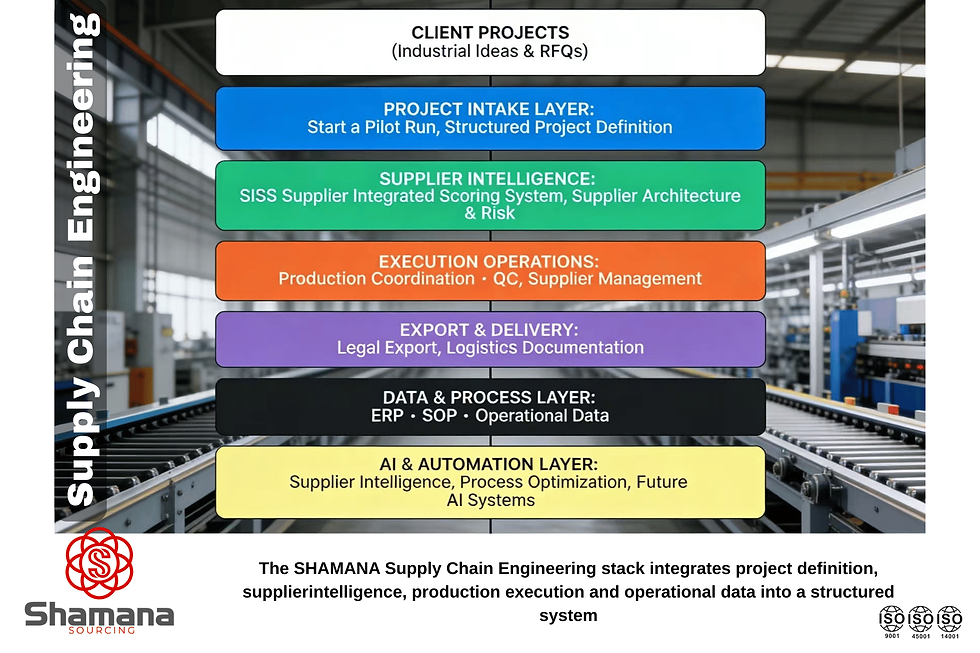
At SHAMANA, audits are not a product.They are a control layer inside the sourcing process.
The same team that assesses the supplier:
participates in production support
oversees QC gates
manages export execution
This continuity is what turns information into control.
5. When SHAMANA says “no” to a supplier
An important detail most websites will never tell you:
We reject suppliers that:
refuse contractual accountability
hide subcontracting
resist traceability
look good on paper but fail behavioral tests
Walking away early saves more money than negotiating harder later.
6. What a real supplier audit is supposed to achieve
A proper supplier assessment should not answer:
“Is this factory good?”
It should answer:
“Is this supplier the right execution system for this specific project?”
That is a very different question.
And it requires:
engineering understanding
commercial realism
on-the-ground experience
and the willingness to say “no”
Final note
If you are looking for a certificate check, almost anyone can do it.
If you are looking for:
predictability
risk visibility
and execution control
Then supplier assessment must be treated as engineering, not paperwork.
That is how we built our internal audit system.And that is why we treat sourcing as a controlled process, not a marketplace search.
Optional CTA (soft, non-salesy)
If you already have a supplier and want to know where the real risks are, start with an assessment — before production starts.