Why Complex Industrial Products Need Supply Chain Engineering — Not Just China Sourcing
For many companies, sourcing from China still follows a simple logic:
Send RFQ.
Compare suppliers.
Place order.
Ship the product.
For simple products this approach works.
But once a project involves multiple suppliers, engineering adjustments, compliance requirements or custom manufacturing, traditional sourcing methods often start to fail.
The problem is rarely China itself.
The problem is execution architecture.

Industrial projects rarely involve a single supplier or process.
The hidden gap between product design and manufacturing
Many companies assume that once a product design exists, the product is ready for manufacturing.
In reality, industrial projects almost always require additional layers of coordination:
design for manufacturing adjustments
supplier capability validation
production supervision
logistics and export execution.
Without these layers, projects frequently encounter delays, unexpected costs or quality issues.
This gap between design and manufacturing is where many sourcing projects break down.
From traditional sourcing to Supply Chain Engineering
Over time, SHAMANA’s operations evolved beyond traditional sourcing.
Working with complex industrial projects revealed that supplier identification alone is not sufficient.
Projects require structured execution systems.
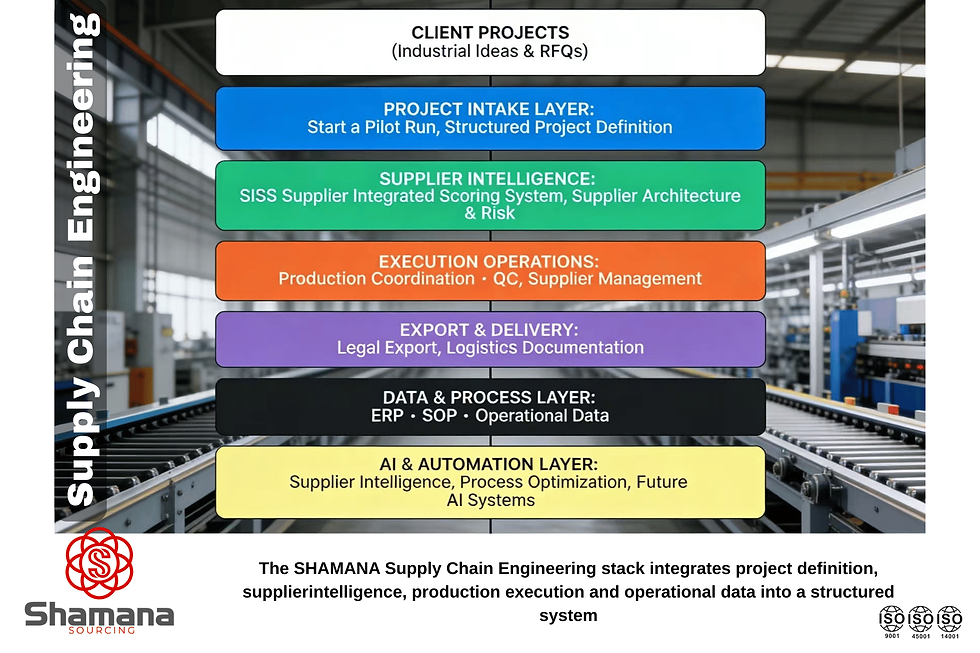
This led to the development of what we call Supply Chain Engineering.
Instead of focusing only on price and supplier comparison, this approach focuses on designing and executing reliable manufacturing systems.
Structuring projects before supplier selection
One of the most critical steps in industrial sourcing is defining the project correctly before supplier selection begins.
To address this challenge, SHAMANA developed a structured intake process called:
Start a Pilot Run
This system transforms a simple client request into a clearly defined manufacturing project.
It helps clarify:
product objectives
production complexity
cost targets
compliance requirements.

Evaluating suppliers through structured analysis
Supplier selection is often treated as a simple price comparison exercise.
In reality, reliable manufacturing depends on much more than price.
To structure supplier evaluation, SHAMANA developed the Supplier Integrated Scoring System (SISS).
This internal operational system helps analyze supplier proposals based on multiple criteria such as:
technical capability
production capacity
quotation structure
risk indicators.
Instead of comparing prices alone, the system helps build a supplier architecture capable of executing the project reliably.

Industrial products require integration
Modern industrial products rarely come from a single factory.
A typical project may involve:
metal fabrication
electronics
cable assemblies
mechanical components
final assembly and testing.
Managing these elements requires coordination across multiple suppliers and processes.
This is where supply chain engineering becomes essential.
Integrated services, not isolated tasks
Unlike traditional sourcing providers, SHAMANA services are not designed as isolated tasks.
Supplier validation, production supervision, export execution and logistics coordination operate as a single integrated execution system.
This approach helps reduce project risks while improving reliability and transparency.
The future of industrial sourcing
As products become more complex and global supply chains continue to evolve, sourcing alone is no longer sufficient.
Companies increasingly need partners capable of integrating engineering, suppliers and execution into a coherent production system.
At SHAMANA, our objective is to build exactly that.
A structured and transparent operational model that transforms ideas into reliable industrial products manufactured in China.
If you are planning a new industrial project and want to explore how structured supply chain engineering can improve execution reliability: